
Seamless Rain Gutters in Arkansas (AR)
Anywhere in Arkansas, the forming machine comes to the house. One continuous gutter per run, downspouts sized to match, one written figure for all of it.
The call costs nothing and commits you to nothing. Any trip fee for the measure is named when the date is set, and the written figure follows the measure.
- Counties covered
- 75
- Region
- South
- Largest city
- Little Rock
Why high quality water runoff systems matter in Arkansas
Seamless rain channels represent the most reliable way to direct heavy storm flow away from your foundation. These continuous metal troughs prevent leaks by removing joints where clogs and drips usually start. Getting a setup installed now protects your property from water damage and soil erosion during those intense southern downpours.
Properly fitted roof drainage hardware manages rainfall efficiently while keeping your siding dry. This hardware stops splashback from ruining your exterior paint or rotting your wood trim. Since moisture control remains vital for structural longevity, selecting a custom fit ensures your home stays in top shape.
The benefits of choosing continuous metal drainage
Choosing a custom cut channel means you get a perfect match for your roofline. Because it comes in one long piece, you avoid the common headache of leaky seams. That structural integrity means you spend less time cleaning out debris and more time enjoying your weekends without worrying about leaks.
Metal durability offers another major advantage when dealing with local weather patterns. Aluminum or copper options withstand harsh sun and freezing temperatures without warping or cracking. This toughness saves you money over time by reducing the need for constant maintenance or patching.
How to identify a quality installation
A professional setup should always include sturdy hidden hangers that stay out of sight. These supports hold the weight of heavy ice or wet leaves without pulling away from your fascia boards. Asking your installer about their choice of fasteners helps you understand how well the system will hold up over time.
Selecting the right downspout placement also matters quite a bit for effective drainage. Strategic positioning carries water far from your basement or crawl space to keep the ground stable. You should verify that the pro understands local drainage codes so your home remains safe during seasonal storms.
What to consider before you start your project
Investing in a new drainage layout requires looking for a licensed and insured technician to handle the job correctly. Make sure you check if they offer a written warranty on their labor and materials. This safety step ensures you have support if any issues arise after the work is finished.
Taking the time to compare quotes allows you to find a pro who fits your budget. Getting a free estimate lets you see the range of options for colors and material types available. Requesting a quote today helps you move forward with a plan to keep your house dry and secure throughout the year.
Taking the next step for your home
Planning for your new water management system starts by describing your specific project needs to a local pro. Providing details about your roof style or the height of your home helps them prepare for your specific situation. You can easily request a free quote to get started on your home improvements today.
Why one piece beats twenty-two
A sectional gutter arrives from a shelf in short lengths and gets stitched together on your fascia. A seamless gutter leaves our machine as a single ribbon of aluminum, already the length of the run it will serve. Everything below follows from that difference.
Profiles and sizes we roll
The machine changes its forming head, not its habits. Whichever profile your house calls for, the run still comes off the coil in one piece.
Not sure which size your roof sheds into? That is a measuring question, not a guessing question, and one call books the measure.
The craft, run by run
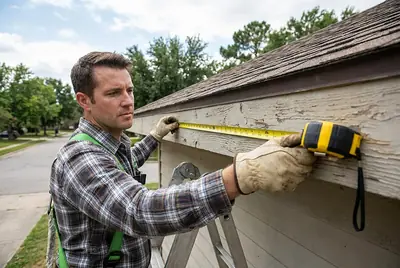
The measure that rules the job
Every fascia gets walked and taped before anything is ordered. The numbers written that day are the numbers the machine obeys.
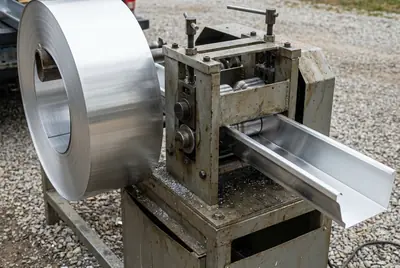
Forming at the curb
Flat coil goes into the roll former on the truck and a finished gutter profile comes out, cut off at the length of your run and not an inch more.
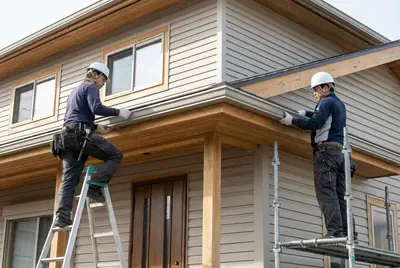
Hanging to a true pitch
Hidden hangers screwed into sound fascia, spaced for snow country where it applies, with a fall toward the outlet you can check with a hose.
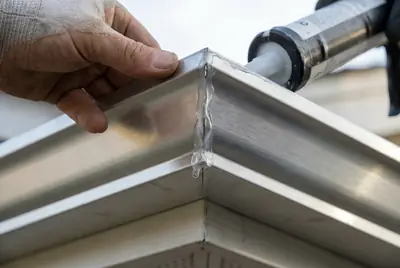
Corners mitered by hand
The only seams a seamless system has live at the corners, so ours are cut, lapped, riveted and sealed like they matter. Because they do.
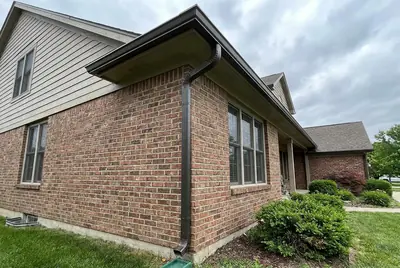
Downspouts that finish the story
Sized to the gutter that feeds them, dropped where the water should land, with extensions that carry it clear of the foundation.
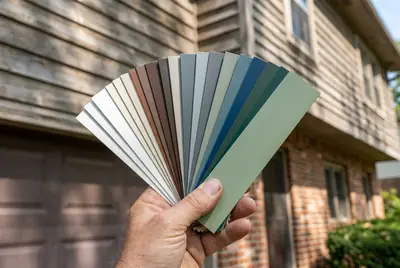
Color read against your trim
Factory painted coil comes in dozens of stock shades. We hold the chart against your fascia in daylight, not in a catalog.
The machine comes to you
Call the crew
One call to (855) 629-1479: ZIP, the kind of run and a word on the roofline. Under a minute, and nothing else is asked of you yet.
The measurer listens
On that same call the measurer hears the roofline out and books a time that suits the house.
Tape on fascia
Runs, drops, corners and colors are measured and settled on site. You get one written figure that holds.
The machine arrives
Forming day. The truck parks, the coil rolls, and each gutter comes off at the exact length it was measured for.
Hung and rinsed
Runs go up on hidden hangers, corners are sealed, downspouts dropped, and water is run through before we pull away.
What a foot of gutter costs
Stories, ladder access and fascia condition move a footage price up or down, which is why we measure before we promise. The figure you sign is the figure you pay.
Color comes off the coil, not out of a paint can
Seamless gutter stock arrives as factory painted aluminum coil, baked finish on both faces, in dozens of standing shades from bright white through bronzes and into true black. Because the color is cured onto the metal before it ever reaches the forming machine, it does not brush off, and it weathers evenly along the whole run.
Matching is done at your house. The measurer brings the coil chart to the fascia and reads it in your daylight, against your trim, your siding and your roof edge. Most homes want the gutter to disappear into the trim line; some want the downspouts to vanish against the siding instead, and the two choices are allowed to differ. If your trim sits between two stock shades, we will say so plainly and show you both instead of promising a custom tint we cannot roll.
What homeowners ask before signing
What does seamless actually mean here?
Each straight run is one continuous piece of metal, formed at your house to the length of that fascia. The only joints in the whole system sit at corners and outlets, where they are riveted and sealed by hand.
How long does the machine spend at my house?
For most homes the forming and the hanging fit inside a single visit. Long wraparound rooflines or three stories of ladder work can stretch it, and the quote says so before anyone commits.
Can you really match my trim color?
From dozens of factory painted coil shades, almost always closely enough that visitors never think about it. When your trim falls between two stock shades, you see both charts at the fascia and pick with your own eyes.
What happens to the gutters already on the house?
They come down the same day, fasteners and all, and leave in our truck for recycling. The tear off is its own line on the written quote, never a surprise.
Are corners a weak point?
They are the only seams the system has, which is exactly why they get the slow treatment: hand cut miters, riveted laps and sealant rated for wet metal. A corner done that way outlives the sealant tube it came from many times over.
Is a small house worth a seamless run?
Yes, the machine rolls a 20 ft run as happily as a 60 ft one. A small job minimum applies because the truck travels whole, and it is printed on the quote so you can judge it in writing.
Rooflines around Arkansas
The terrain sets the pitch and the trees set the debris. The lists further down name every community the truck reaches from here.
County lines of Arkansas
- Seamless Rain Gutters in Arkansas County, AR
- Seamless Rain Gutters in Ashley County, AR
- Seamless Rain Gutters in Baxter County, AR
- Seamless Rain Gutters in Benton County, AR
- Seamless Rain Gutters in Boone County, AR
- Seamless Rain Gutters in Bradley County, AR
- Seamless Rain Gutters in Calhoun County, AR
- Seamless Rain Gutters in Carroll County, AR
- Seamless Rain Gutters in Chicot County, AR
- Seamless Rain Gutters in Clark County, AR
- Seamless Rain Gutters in Clay County, AR
- Seamless Rain Gutters in Cleburne County, AR
- Seamless Rain Gutters in Cleveland County, AR
- Seamless Rain Gutters in Columbia County, AR
- Seamless Rain Gutters in Conway County, AR
- Seamless Rain Gutters in Craighead County, AR
- Seamless Rain Gutters in Crawford County, AR
- Seamless Rain Gutters in Crittenden County, AR
- Seamless Rain Gutters in Cross County, AR
- Seamless Rain Gutters in Dallas County, AR
- Seamless Rain Gutters in Desha County, AR
- Seamless Rain Gutters in Drew County, AR
- Seamless Rain Gutters in Faulkner County, AR
- Seamless Rain Gutters in Franklin County, AR
- Seamless Rain Gutters in Fulton County, AR
- Seamless Rain Gutters in Garland County, AR
- Seamless Rain Gutters in Grant County, AR
- Seamless Rain Gutters in Greene County, AR
- Seamless Rain Gutters in Hempstead County, AR
- Seamless Rain Gutters in Hot Spring County, AR
The busiest eaves in Arkansas
- Seamless Rain Gutters in Little Rock, AR (home to 198,135)
- Seamless Rain Gutters in Morning Star, AR (home to 97,177)
- Seamless Rain Gutters in Fort Smith, AR (home to 87,639)
- Seamless Rain Gutters in Fayetteville, AR (home to 83,736)
- Seamless Rain Gutters in Springdale, AR (home to 78,690)
- Seamless Rain Gutters in Jonesboro, AR (home to 74,710)
- Seamless Rain Gutters in North Little Rock, AR (home to 66,282)
- Seamless Rain Gutters in Conway, AR (home to 65,069)
- Seamless Rain Gutters in Rogers, AR (home to 64,947)
- Seamless Rain Gutters in Bentonville, AR (home to 46,857)
- Seamless Rain Gutters in Homan, AR (home to 43,908)
- Seamless Rain Gutters in Pine Bluff, AR (home to 43,840)
- Seamless Rain Gutters in Hot Springs National Park, AR (home to 35,193)
- Seamless Rain Gutters in Benton, AR (home to 34,873)
- Seamless Rain Gutters in Sherwood, AR (home to 30,812)
- Seamless Rain Gutters in Gertrude, AR (home to 30,353)
- Seamless Rain Gutters in Lakewood Estates, AR (home to 30,353)
- Seamless Rain Gutters in Texarkana, AR (home to 30,104)
- Seamless Rain Gutters in Russellville, AR (home to 29,244)
- Seamless Rain Gutters in Jacksonville, AR (home to 28,588)
- Seamless Rain Gutters in Bella Vista, AR (home to 28,328)
- Seamless Rain Gutters in Paragould, AR (home to 28,296)
- Seamless Rain Gutters in Cabot, AR (home to 26,176)
- Seamless Rain Gutters in West Memphis, AR (home to 25,009)
- Seamless Rain Gutters in Searcy, AR (home to 23,853)
- Seamless Rain Gutters in Van Buren, AR (home to 23,296)
- Seamless Rain Gutters in Lucas, AR (home to 21,714)
- Seamless Rain Gutters in Bryant, AR (home to 19,944)
- Seamless Rain Gutters in El Dorado, AR (home to 18,129)
- Seamless Rain Gutters in Maumelle, AR (home to 18,053)
Next door in the South
- Seamless Rain Gutters in Alabama
- Seamless Rain Gutters in Delaware
- Seamless Rain Gutters in Florida
- Seamless Rain Gutters in Georgia
- Seamless Rain Gutters in Kentucky
- Seamless Rain Gutters in Louisiana
- Seamless Rain Gutters in Maryland
- Seamless Rain Gutters in Mississippi
- Seamless Rain Gutters in North Carolina
- Seamless Rain Gutters in Oklahoma
- Seamless Rain Gutters in South Carolina
- Seamless Rain Gutters in Tennessee
- Seamless Rain Gutters in Texas
- Seamless Rain Gutters in Virginia
- Seamless Rain Gutters in Washington, D.C.
- Seamless Rain Gutters in West Virginia
One ribbon of metal per run, and the drips have nowhere left to start.
Call (855) 629-1479