
Seamless Rain Gutters in Nemaha County, Nebraska (NE)
From one end of Nemaha County to the other, our crews form gutters on site so each run goes up whole, with the coil color settled against your trim first.
The call costs nothing and commits you to nothing. Any trip fee for the measure is named when the date is set, and the written figure follows the measure.
Keeping your home dry with custom metal channels
Investing in custom metal troughs for your roofline stops water from damaging your home foundation or exterior walls. These continuous lengths are fabricated right on your property to perfectly match the exact dimensions of your eaves. Getting a free quote from a pro in Nemaha County helps you prevent costly moisture issues.
Why these troughs beat the traditional style
Traditional drainage systems have many seams that eventually leak and cause a real headache for homeowners. Choosing a seamless design removes those weak points entirely, which means you avoid the frustration of constant dripping and rot. You get a sleek look that guards your siding while keeping the house in great shape.
Furthermore, these custom channels handle heavy rainfall much better than sectional versions that clog easily. That superior flow capacity ensures water moves away from your roof quickly during intense Nebraska storms. You gain peace of mind because the system manages high volume without spilling over onto your walkways.
Selecting the right material for your roof
Aluminum remains a top pick around here because it does not rust and stays light enough for any structure. Heavy gauge steel offers even more durability if you live in an area with lots of ice buildup or falling branches. Making the right choice means your drainage setup will last for decades without needing major repairs.
Picking a durable finish also protects the metal from sun damage and keeps the color looking fresh. That added layer of defense prevents peeling or fading that makes a property look aged and neglected. You end up with a high level of structural integrity that boosts your curb appeal instantly.
Working with a local pro
Finding someone who knows the local climate and common architectural styles in this region is smart. A good contractor arrives with a specialized machine to form the metal to your exact measurements on-site. You should always ask for proof of insurance and a written warranty before letting anyone start the job.
Checking that the installer follows local codes ensures the slope is perfect for gravity to do its work. Getting this step right keeps water moving toward the downspouts instead of pooling near the roof edges. You deserve a reliable drainage solution that functions flawlessly through every single season.
Table of material benefits
| Material | Primary Benefit | Maintenance Level |
|---|---|---|
| Aluminum | Resists rust well | Low effort |
| Galvanized Steel | Strong impact resistance | Moderate care |
| Copper | High aesthetic value | Periodic cleaning |
Understanding the installation process
Technicians start by measuring the perimeter of your roof to ensure the metal pieces fit like a glove. They then feed a coil of material through a machine that creates the specific profile you choose. This process happens outside your house, which makes the whole project clean and very efficient.
Once the metal is formed, the crew secures it using sturdy hangers that hold everything in place. These hidden brackets support the weight of heavy water without being visible from the ground below. You enjoy a seamless appearance that hides all the mechanical parts from view.
Protecting your investment
Cleaning out debris remains the one task you must handle to keep these channels working at their peak. Installing high-quality gutter guards can stop leaves and twigs from ever getting inside the system. That simple addition saves you from climbing ladders and keeps the water flowing perfectly all year round.
Ignoring clogs can lead to significant water damage that ruins paint and wood trim on your exterior. Taking a proactive approach keeps the home value high and prevents expensive structural fixes later on. You should act today to secure your property by describing your project for a free quote.
Final steps for your project
When you want to stop leaks and protect your foundation, reaching out to local experts is the move. Simply share the details of your roof layout and your specific needs to get a price estimate. Getting a professional opinion ensures your water diversion system handles the local weather conditions perfectly.
Requesting your free quote today puts you on the path toward a safer and drier living space. You deserve a setup that provides long-term protection against the elements without any added stress or worry. Talk to a pro now to start your upgrade and enjoy the relief of a worry-free roofline.
Why one piece beats twenty-two
A sectional gutter arrives from a shelf in short lengths and gets stitched together on your fascia. A seamless gutter leaves our machine as a single ribbon of aluminum, already the length of the run it will serve. Everything below follows from that difference.
Profiles and sizes we roll
The machine changes its forming head, not its habits. Whichever profile your house calls for, the run still comes off the coil in one piece.
Not sure which size your roof sheds into? That is a measuring question, not a guessing question, and one call books the measure.
The craft, run by run
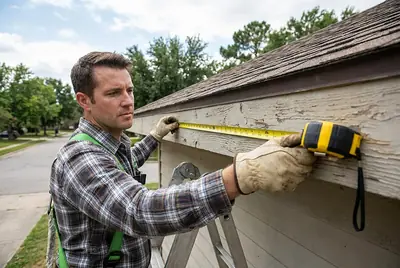
The measure that rules the job
Every fascia gets walked and taped before anything is ordered. The numbers written that day are the numbers the machine obeys.
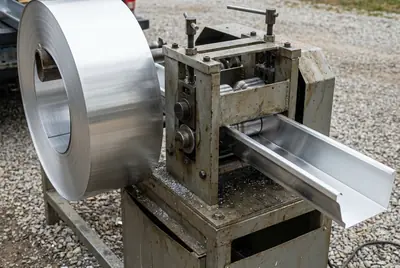
Forming at the curb
Flat coil goes into the roll former on the truck and a finished gutter profile comes out, cut off at the length of your run and not an inch more.
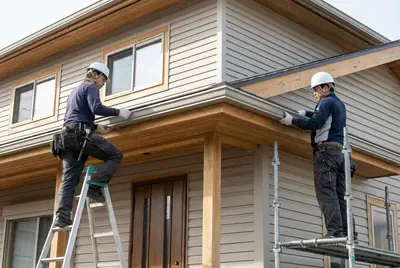
Hanging to a true pitch
Hidden hangers screwed into sound fascia, spaced for snow country where it applies, with a fall toward the outlet you can check with a hose.
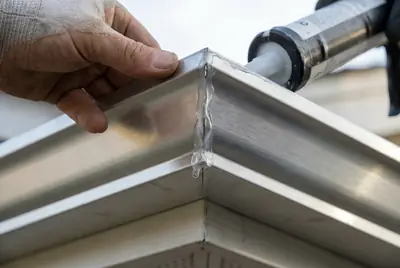
Corners mitered by hand
The only seams a seamless system has live at the corners, so ours are cut, lapped, riveted and sealed like they matter. Because they do.
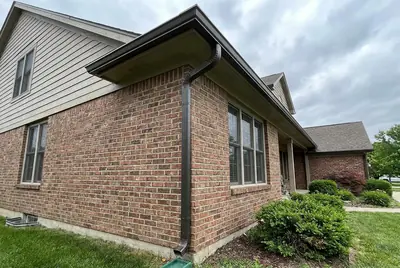
Downspouts that finish the story
Sized to the gutter that feeds them, dropped where the water should land, with extensions that carry it clear of the foundation.
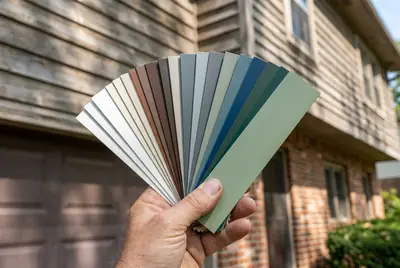
Color read against your trim
Factory painted coil comes in dozens of stock shades. We hold the chart against your fascia in daylight, not in a catalog.
The machine comes to you
Call the crew
One call to (855) 629-1479: ZIP, the kind of run and a word on the roofline. Under a minute, and nothing else is asked of you yet.
The measurer listens
On that same call the measurer hears the roofline out and books a time that suits the house.
Tape on fascia
Runs, drops, corners and colors are measured and settled on site. You get one written figure that holds.
The machine arrives
Forming day. The truck parks, the coil rolls, and each gutter comes off at the exact length it was measured for.
Hung and rinsed
Runs go up on hidden hangers, corners are sealed, downspouts dropped, and water is run through before we pull away.
What a foot of gutter costs
Stories, ladder access and fascia condition move a footage price up or down, which is why we measure before we promise. The figure you sign is the figure you pay.
Color comes off the coil, not out of a paint can
Seamless gutter stock arrives as factory painted aluminum coil, baked finish on both faces, in dozens of standing shades from bright white through bronzes and into true black. Because the color is cured onto the metal before it ever reaches the forming machine, it does not brush off, and it weathers evenly along the whole run.
Matching is done at your house. The measurer brings the coil chart to the fascia and reads it in your daylight, against your trim, your siding and your roof edge. Most homes want the gutter to disappear into the trim line; some want the downspouts to vanish against the siding instead, and the two choices are allowed to differ. If your trim sits between two stock shades, we will say so plainly and show you both instead of promising a custom tint we cannot roll.
What homeowners ask before signing
What does seamless actually mean here?
Each straight run is one continuous piece of metal, formed at your house to the length of that fascia. The only joints in the whole system sit at corners and outlets, where they are riveted and sealed by hand.
How long does the machine spend at my house?
For most homes the forming and the hanging fit inside a single visit. Long wraparound rooflines or three stories of ladder work can stretch it, and the quote says so before anyone commits.
Can you really match my trim color?
From dozens of factory painted coil shades, almost always closely enough that visitors never think about it. When your trim falls between two stock shades, you see both charts at the fascia and pick with your own eyes.
What happens to the gutters already on the house?
They come down the same day, fasteners and all, and leave in our truck for recycling. The tear off is its own line on the written quote, never a surprise.
Are corners a weak point?
They are the only seams the system has, which is exactly why they get the slow treatment: hand cut miters, riveted laps and sealant rated for wet metal. A corner done that way outlives the sealant tube it came from many times over.
Is a small house worth a seamless run?
Yes, the machine rolls a 20 ft run as happily as a 60 ft one. A small job minimum applies because the truck travels whole, and it is printed on the quote so you can judge it in writing.
Rooflines around Nemaha County
The terrain sets the pitch and the trees set the debris. The lists further down name every community the truck reaches from here.
Towns of Nemaha County on our route sheet
- Seamless Rain Gutters in Auburn, NE (home to 3,322)
- Seamless Rain Gutters in Peru, NE (home to 898)
- Seamless Rain Gutters in Johnson, NE (home to 320)
- Seamless Rain Gutters in Nemaha, NE (home to 118)
- Seamless Rain Gutters in Brock, NE (home to 116)
- Seamless Rain Gutters in Brownville, NE (home to 99)
- Seamless Rain Gutters in Julian, NE (home to 53)
The rest of Nebraska, county after county
- Seamless Rain Gutters in Adams County, NE
- Seamless Rain Gutters in Antelope County, NE
- Seamless Rain Gutters in Arthur County, NE
- Seamless Rain Gutters in Banner County, NE
- Seamless Rain Gutters in Blaine County, NE
- Seamless Rain Gutters in Boone County, NE
- Seamless Rain Gutters in Box Butte County, NE
- Seamless Rain Gutters in Boyd County, NE
- Seamless Rain Gutters in Brown County, NE
- Seamless Rain Gutters in Buffalo County, NE
- Seamless Rain Gutters in Burt County, NE
- Seamless Rain Gutters in Butler County, NE
- Seamless Rain Gutters in Cass County, NE
- Seamless Rain Gutters in Cedar County, NE
- Seamless Rain Gutters in Chase County, NE
- Seamless Rain Gutters in Cherry County, NE
- Seamless Rain Gutters in Cheyenne County, NE
- Seamless Rain Gutters in Clay County, NE
- Seamless Rain Gutters in Colfax County, NE
- Seamless Rain Gutters in Cuming County, NE
- Seamless Rain Gutters in Custer County, NE
- Seamless Rain Gutters in Dakota County, NE
- Seamless Rain Gutters in Dawes County, NE
- Seamless Rain Gutters in Dawson County, NE
- Seamless Rain Gutters in Deuel County, NE
- Seamless Rain Gutters in Dixon County, NE
- Seamless Rain Gutters in Dodge County, NE
- Seamless Rain Gutters in Douglas County, NE
- Seamless Rain Gutters in Dundy County, NE
- Seamless Rain Gutters in Fillmore County, NE
One ribbon of metal per run, and the drips have nowhere left to start.
Call (855) 629-1479