
Seamless Rain Gutters in Franklin County, Indiana (IN)
From one end of Franklin County to the other, our crews form gutters on site so each run goes up whole, with the coil color settled against your trim first.
The call costs nothing and commits you to nothing. Any trip fee for the measure is named when the date is set, and the written figure follows the measure.
Why you need a custom water drainage system for your home in Franklin County
Installing these precise metal channels around your roofline stops rainwater from dumping directly onto your foundation. That simple diversion prevents costly basement leaks and protects your siding from rot and unsightly mold growth.
You probably know that stagnant water is the enemy of any sturdy structure. These systems redirect heavy runoff away from your house through a single, continuous run. This eliminates weak spots where leaks usually start.
How continuous metal troughs handle Indiana weather
Heavy downpours often overwhelm traditional segmented pipes that have multiple joints. Those seams eventually pull apart because of thermal expansion or debris buildup. That constant movement causes annoying drips that ruin your landscaping.
Seamless fabrication solves this issue by creating a custom fit for your eaves. Technicians use a specialized machine to roll-form the material right on your driveway. Which means you get a perfect length that spans the entire side of your roof without any gaps.
Choosing the right material for your roof
Aluminum is a popular choice around here because it resists rust and remains lightweight. It handles the local temperature swings without warping or cracking under pressure. That durability gives you peace of mind during those unpredictable spring storms.
Copper offers a high-end look while providing incredible longevity for your residence. It develops a rich patina that actually protects the metal from further corrosion. While it costs more upfront, the lifespan makes it a smart investment for your property.
Why proper slope is essential
Water needs a slight pitch to flow toward the downspouts effectively. A pro ensures that the fall is steep enough to move debris but subtle enough to look level. This precision prevents standing pools that could eventually lead to rusting or insect infestations.
Poorly installed systems often sag because they lack heavy-duty hangers. You should look for someone who uses hidden bracket fasteners spaced closely together. That stability keeps the troughs perfectly aligned even under the weight of heavy ice or wet leaves.
Protecting your investment with professional installation
Local code requirements often dictate how and where downspouts must terminate. A knowledgeable installer knows exactly how to direct that water into splash blocks or underground pipes. Which ensures your lawn stays dry and your soil remains stable.
You deserve a setup that functions perfectly and looks sharp on your home. Ask any potential installer about their local licensing and if they carry proper insurance coverage. That extra step ensures you are protected while they work on your roofline.
Take the next step for your home
Now that you understand the mechanics, you can plan your upgrade with confidence. You should describe your specific project needs to get a free quote from a pro near you. That simple action helps you secure your home against water damage for good.
Why one piece beats twenty-two
A sectional gutter arrives from a shelf in short lengths and gets stitched together on your fascia. A seamless gutter leaves our machine as a single ribbon of aluminum, already the length of the run it will serve. Everything below follows from that difference.
Profiles and sizes we roll
The machine changes its forming head, not its habits. Whichever profile your house calls for, the run still comes off the coil in one piece.
Not sure which size your roof sheds into? That is a measuring question, not a guessing question, and one call books the measure.
The craft, run by run
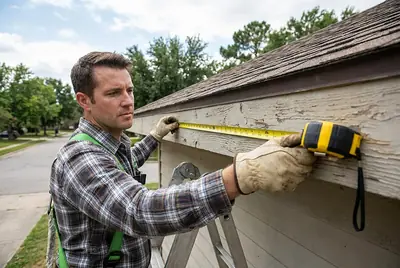
The measure that rules the job
Every fascia gets walked and taped before anything is ordered. The numbers written that day are the numbers the machine obeys.
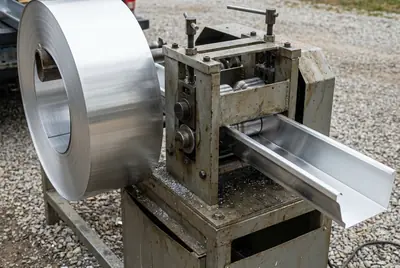
Forming at the curb
Flat coil goes into the roll former on the truck and a finished gutter profile comes out, cut off at the length of your run and not an inch more.
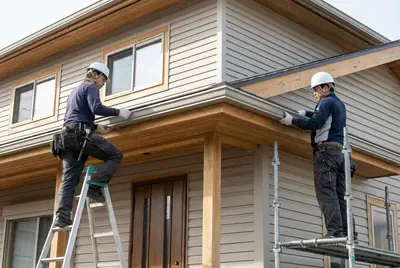
Hanging to a true pitch
Hidden hangers screwed into sound fascia, spaced for snow country where it applies, with a fall toward the outlet you can check with a hose.
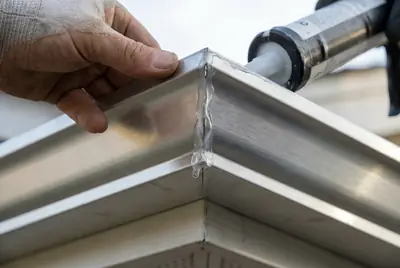
Corners mitered by hand
The only seams a seamless system has live at the corners, so ours are cut, lapped, riveted and sealed like they matter. Because they do.
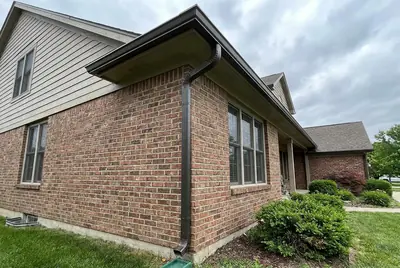
Downspouts that finish the story
Sized to the gutter that feeds them, dropped where the water should land, with extensions that carry it clear of the foundation.
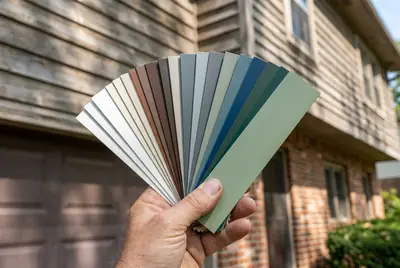
Color read against your trim
Factory painted coil comes in dozens of stock shades. We hold the chart against your fascia in daylight, not in a catalog.
The machine comes to you
Call the crew
One call to (855) 629-1479: ZIP, the kind of run and a word on the roofline. Under a minute, and nothing else is asked of you yet.
The measurer listens
On that same call the measurer hears the roofline out and books a time that suits the house.
Tape on fascia
Runs, drops, corners and colors are measured and settled on site. You get one written figure that holds.
The machine arrives
Forming day. The truck parks, the coil rolls, and each gutter comes off at the exact length it was measured for.
Hung and rinsed
Runs go up on hidden hangers, corners are sealed, downspouts dropped, and water is run through before we pull away.
What a foot of gutter costs
Stories, ladder access and fascia condition move a footage price up or down, which is why we measure before we promise. The figure you sign is the figure you pay.
Color comes off the coil, not out of a paint can
Seamless gutter stock arrives as factory painted aluminum coil, baked finish on both faces, in dozens of standing shades from bright white through bronzes and into true black. Because the color is cured onto the metal before it ever reaches the forming machine, it does not brush off, and it weathers evenly along the whole run.
Matching is done at your house. The measurer brings the coil chart to the fascia and reads it in your daylight, against your trim, your siding and your roof edge. Most homes want the gutter to disappear into the trim line; some want the downspouts to vanish against the siding instead, and the two choices are allowed to differ. If your trim sits between two stock shades, we will say so plainly and show you both instead of promising a custom tint we cannot roll.
What homeowners ask before signing
What does seamless actually mean here?
Each straight run is one continuous piece of metal, formed at your house to the length of that fascia. The only joints in the whole system sit at corners and outlets, where they are riveted and sealed by hand.
How long does the machine spend at my house?
For most homes the forming and the hanging fit inside a single visit. Long wraparound rooflines or three stories of ladder work can stretch it, and the quote says so before anyone commits.
Can you really match my trim color?
From dozens of factory painted coil shades, almost always closely enough that visitors never think about it. When your trim falls between two stock shades, you see both charts at the fascia and pick with your own eyes.
What happens to the gutters already on the house?
They come down the same day, fasteners and all, and leave in our truck for recycling. The tear off is its own line on the written quote, never a surprise.
Are corners a weak point?
They are the only seams the system has, which is exactly why they get the slow treatment: hand cut miters, riveted laps and sealant rated for wet metal. A corner done that way outlives the sealant tube it came from many times over.
Is a small house worth a seamless run?
Yes, the machine rolls a 20 ft run as happily as a 60 ft one. A small job minimum applies because the truck travels whole, and it is printed on the quote so you can judge it in writing.
Rooflines around Franklin County
The terrain sets the pitch and the trees set the debris. The lists further down name every community the truck reaches from here.
Towns of Franklin County on our route sheet
- Seamless Rain Gutters in Brookville, IN (home to 2,546)
- Seamless Rain Gutters in Laurel, IN (home to 548)
- Seamless Rain Gutters in Oldenburg, IN (home to 542)
- Seamless Rain Gutters in New Trenton, IN (home to 225)
- Seamless Rain Gutters in Metamora, IN (home to 177)
- Seamless Rain Gutters in Cedar Grove, IN (home to 152)
- Seamless Rain Gutters in Mount Auburn, IN (home to 117)
- Seamless Rain Gutters in Mount Carmel, IN (home to 86)
The rest of Indiana, county after county
- Seamless Rain Gutters in Adams County, IN
- Seamless Rain Gutters in Allen County, IN
- Seamless Rain Gutters in Bartholomew County, IN
- Seamless Rain Gutters in Benton County, IN
- Seamless Rain Gutters in Blackford County, IN
- Seamless Rain Gutters in Boone County, IN
- Seamless Rain Gutters in Brown County, IN
- Seamless Rain Gutters in Carroll County, IN
- Seamless Rain Gutters in Cass County, IN
- Seamless Rain Gutters in Clark County, IN
- Seamless Rain Gutters in Clay County, IN
- Seamless Rain Gutters in Clinton County, IN
- Seamless Rain Gutters in Crawford County, IN
- Seamless Rain Gutters in Daviess County, IN
- Seamless Rain Gutters in DeKalb County, IN
- Seamless Rain Gutters in Dearborn County, IN
- Seamless Rain Gutters in Decatur County, IN
- Seamless Rain Gutters in Delaware County, IN
- Seamless Rain Gutters in Dubois County, IN
- Seamless Rain Gutters in Elkhart County, IN
- Seamless Rain Gutters in Fayette County, IN
- Seamless Rain Gutters in Floyd County, IN
- Seamless Rain Gutters in Fountain County, IN
- Seamless Rain Gutters in Fulton County, IN
- Seamless Rain Gutters in Gibson County, IN
- Seamless Rain Gutters in Grant County, IN
- Seamless Rain Gutters in Greene County, IN
- Seamless Rain Gutters in Hamilton County, IN
- Seamless Rain Gutters in Hancock County, IN
- Seamless Rain Gutters in Harrison County, IN
One ribbon of metal per run, and the drips have nowhere left to start.
Call (855) 629-1479