
Seamless Rain Gutters in Crane County, Texas (TX)
From one end of Crane County to the other, our crews form gutters on site so each run goes up whole, with the coil color settled against your trim first.
The call costs nothing and commits you to nothing. Any trip fee for the measure is named when the date is set, and the written figure follows the measure.
Protecting your foundation with continuous metal water channels
Getting your roof drainage system sorted prevents major damage to your home in Crane County. You need a setup that directs rainfall away from your walls without leaking at every corner. These specific liquid management systems offer you a custom fit that keeps your property safe from erosion.
Choosing a unit made from one long piece of metal ensures that you have fewer weak spots where leaks usually start. Because these channels are formed on site, they match your roofline perfectly. This precision prevents water from dripping behind the fascia boards and rotting your wood trim.
Why this flow control matters
Moving water away from your siding keeps the exterior of your house looking great for much longer. When you avoid moisture buildup, you prevent those ugly streaks and mildew patches that lower your curb appeal. This simple upgrade acts as a guard for your investment while keeping the ground around your home dry.
Installing the right hardware means you stop worrying about pooling water near your foundation slabs. Cracked concrete often comes from constant wetness during heavy storms around here. That is why having a system that channels everything to the downspouts is a smart way to maintain your home.
Picking the right thickness and material
Selecting aluminum or copper for these channels provides you with a rustproof solution that lasts for years. Thicker metal holds up better against heavy debris and large storms common in Texas. Which means you can expect your drainage setup to withstand the elements without bending or sagging under pressure.
Looking at the different hangers and brackets ensures that your setup stays tight against the roof edge. Good hardware keeps the channels level so that water flows properly toward the exits. Proper alignment prevents overflow during sudden downpours and keeps your walkway clear of puddles.
Comparing traditional sections versus continuous designs
| Feature | Traditional Sections | Continuous Units |
| Leak Risk | High at joints | Very low |
| Maintenance | Frequent sealing | Minimal care |
| Appearance | Visible seams | Clean lines |
Opting for a long, custom-formed piece eliminates the need for messy sealants that fail over time. Traditional setups rely on many connection points that shrink and expand with the heat. That creates gaps where water escapes and hits your house instead of the ground.
Selecting the newer style gives you a sleek look that blends right into your roof architecture. You get a tidy finish that does not distract from the character of your home. Plus, the lack of seams makes it much harder for leaves and twigs to get stuck inside.
Taking the next step for your home
Finding a local pro to measure and form these channels ensures a perfect fit for your specific roof size. You should always check that any person you hire carries proper insurance and understands the local building codes. This due diligence gives you the peace of mind that the job is done right.
Getting a free quote allows you to compare options without feeling any pressure to commit. You can describe your house layout and ask about the best colors to match your trim. Start your project today by requesting your estimate and keeping your house dry all year long.
Why one piece beats twenty-two
A sectional gutter arrives from a shelf in short lengths and gets stitched together on your fascia. A seamless gutter leaves our machine as a single ribbon of aluminum, already the length of the run it will serve. Everything below follows from that difference.
Profiles and sizes we roll
The machine changes its forming head, not its habits. Whichever profile your house calls for, the run still comes off the coil in one piece.
Not sure which size your roof sheds into? That is a measuring question, not a guessing question, and one call books the measure.
The craft, run by run
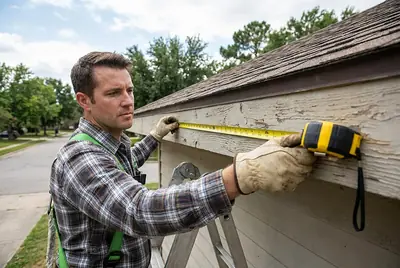
The measure that rules the job
Every fascia gets walked and taped before anything is ordered. The numbers written that day are the numbers the machine obeys.
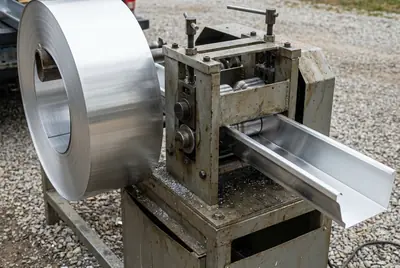
Forming at the curb
Flat coil goes into the roll former on the truck and a finished gutter profile comes out, cut off at the length of your run and not an inch more.
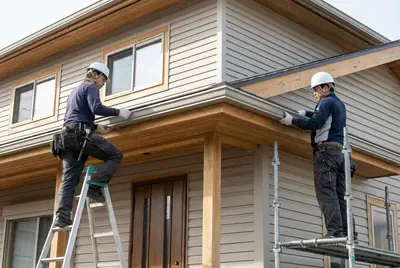
Hanging to a true pitch
Hidden hangers screwed into sound fascia, spaced for snow country where it applies, with a fall toward the outlet you can check with a hose.
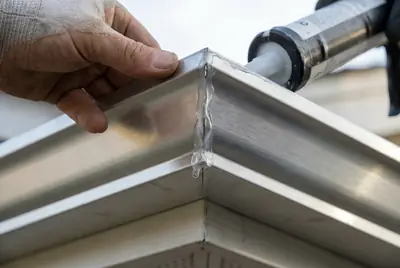
Corners mitered by hand
The only seams a seamless system has live at the corners, so ours are cut, lapped, riveted and sealed like they matter. Because they do.
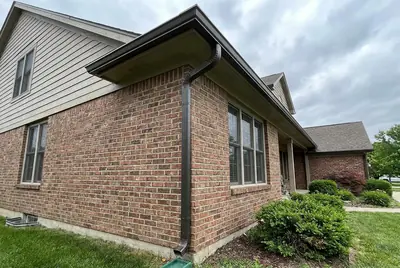
Downspouts that finish the story
Sized to the gutter that feeds them, dropped where the water should land, with extensions that carry it clear of the foundation.
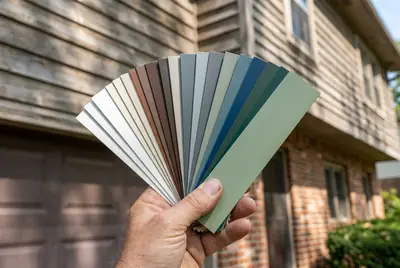
Color read against your trim
Factory painted coil comes in dozens of stock shades. We hold the chart against your fascia in daylight, not in a catalog.
The machine comes to you
Call the crew
One call to (855) 629-1479: ZIP, the kind of run and a word on the roofline. Under a minute, and nothing else is asked of you yet.
The measurer listens
On that same call the measurer hears the roofline out and books a time that suits the house.
Tape on fascia
Runs, drops, corners and colors are measured and settled on site. You get one written figure that holds.
The machine arrives
Forming day. The truck parks, the coil rolls, and each gutter comes off at the exact length it was measured for.
Hung and rinsed
Runs go up on hidden hangers, corners are sealed, downspouts dropped, and water is run through before we pull away.
What a foot of gutter costs
Stories, ladder access and fascia condition move a footage price up or down, which is why we measure before we promise. The figure you sign is the figure you pay.
Color comes off the coil, not out of a paint can
Seamless gutter stock arrives as factory painted aluminum coil, baked finish on both faces, in dozens of standing shades from bright white through bronzes and into true black. Because the color is cured onto the metal before it ever reaches the forming machine, it does not brush off, and it weathers evenly along the whole run.
Matching is done at your house. The measurer brings the coil chart to the fascia and reads it in your daylight, against your trim, your siding and your roof edge. Most homes want the gutter to disappear into the trim line; some want the downspouts to vanish against the siding instead, and the two choices are allowed to differ. If your trim sits between two stock shades, we will say so plainly and show you both instead of promising a custom tint we cannot roll.
What homeowners ask before signing
What does seamless actually mean here?
Each straight run is one continuous piece of metal, formed at your house to the length of that fascia. The only joints in the whole system sit at corners and outlets, where they are riveted and sealed by hand.
How long does the machine spend at my house?
For most homes the forming and the hanging fit inside a single visit. Long wraparound rooflines or three stories of ladder work can stretch it, and the quote says so before anyone commits.
Can you really match my trim color?
From dozens of factory painted coil shades, almost always closely enough that visitors never think about it. When your trim falls between two stock shades, you see both charts at the fascia and pick with your own eyes.
What happens to the gutters already on the house?
They come down the same day, fasteners and all, and leave in our truck for recycling. The tear off is its own line on the written quote, never a surprise.
Are corners a weak point?
They are the only seams the system has, which is exactly why they get the slow treatment: hand cut miters, riveted laps and sealant rated for wet metal. A corner done that way outlives the sealant tube it came from many times over.
Is a small house worth a seamless run?
Yes, the machine rolls a 20 ft run as happily as a 60 ft one. A small job minimum applies because the truck travels whole, and it is printed on the quote so you can judge it in writing.
Rooflines around Crane County
The terrain sets the pitch and the trees set the debris. The lists further down name every community the truck reaches from here.
Towns of Crane County on our route sheet
- Seamless Rain Gutters in Crane, TX (home to 4,051)
The rest of Texas, county after county
- Seamless Rain Gutters in Anderson County, TX
- Seamless Rain Gutters in Andrews County, TX
- Seamless Rain Gutters in Angelina County, TX
- Seamless Rain Gutters in Aransas County, TX
- Seamless Rain Gutters in Archer County, TX
- Seamless Rain Gutters in Armstrong County, TX
- Seamless Rain Gutters in Atascosa County, TX
- Seamless Rain Gutters in Austin County, TX
- Seamless Rain Gutters in Bailey County, TX
- Seamless Rain Gutters in Bandera County, TX
- Seamless Rain Gutters in Bastrop County, TX
- Seamless Rain Gutters in Baylor County, TX
- Seamless Rain Gutters in Bee County, TX
- Seamless Rain Gutters in Bell County, TX
- Seamless Rain Gutters in Bexar County, TX
- Seamless Rain Gutters in Blanco County, TX
- Seamless Rain Gutters in Borden County, TX
- Seamless Rain Gutters in Bosque County, TX
- Seamless Rain Gutters in Bowie County, TX
- Seamless Rain Gutters in Brazoria County, TX
- Seamless Rain Gutters in Brazos County, TX
- Seamless Rain Gutters in Brewster County, TX
- Seamless Rain Gutters in Briscoe County, TX
- Seamless Rain Gutters in Brooks County, TX
- Seamless Rain Gutters in Brown County, TX
- Seamless Rain Gutters in Burleson County, TX
- Seamless Rain Gutters in Burnet County, TX
- Seamless Rain Gutters in Caldwell County, TX
- Seamless Rain Gutters in Calhoun County, TX
- Seamless Rain Gutters in Callahan County, TX
One ribbon of metal per run, and the drips have nowhere left to start.
Call (855) 629-1479